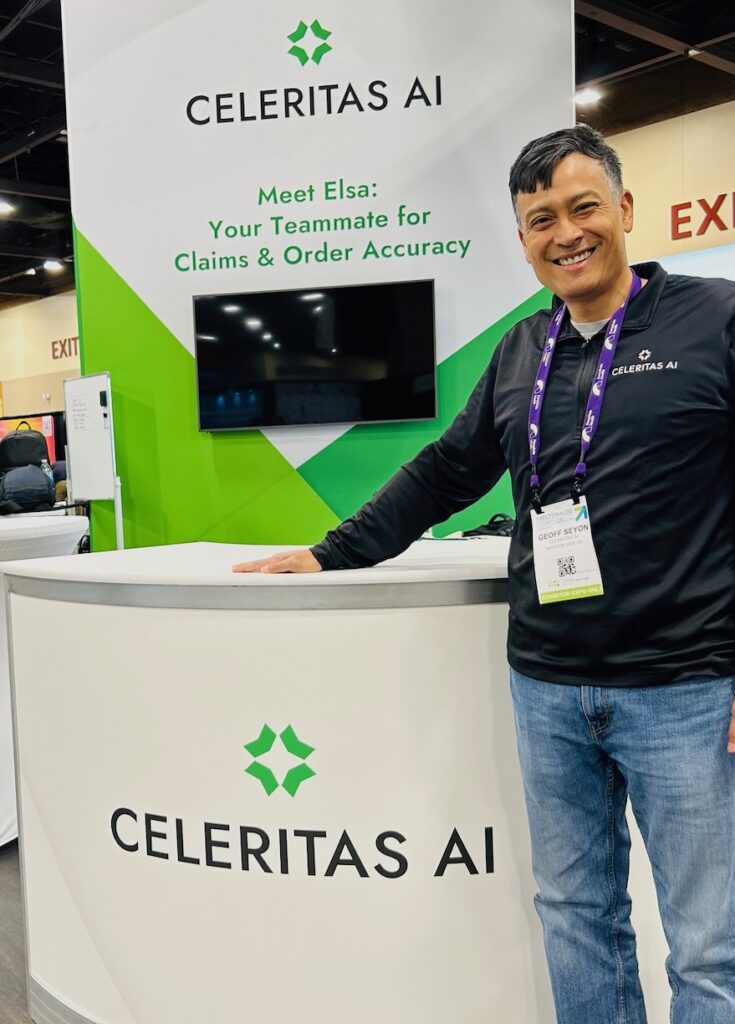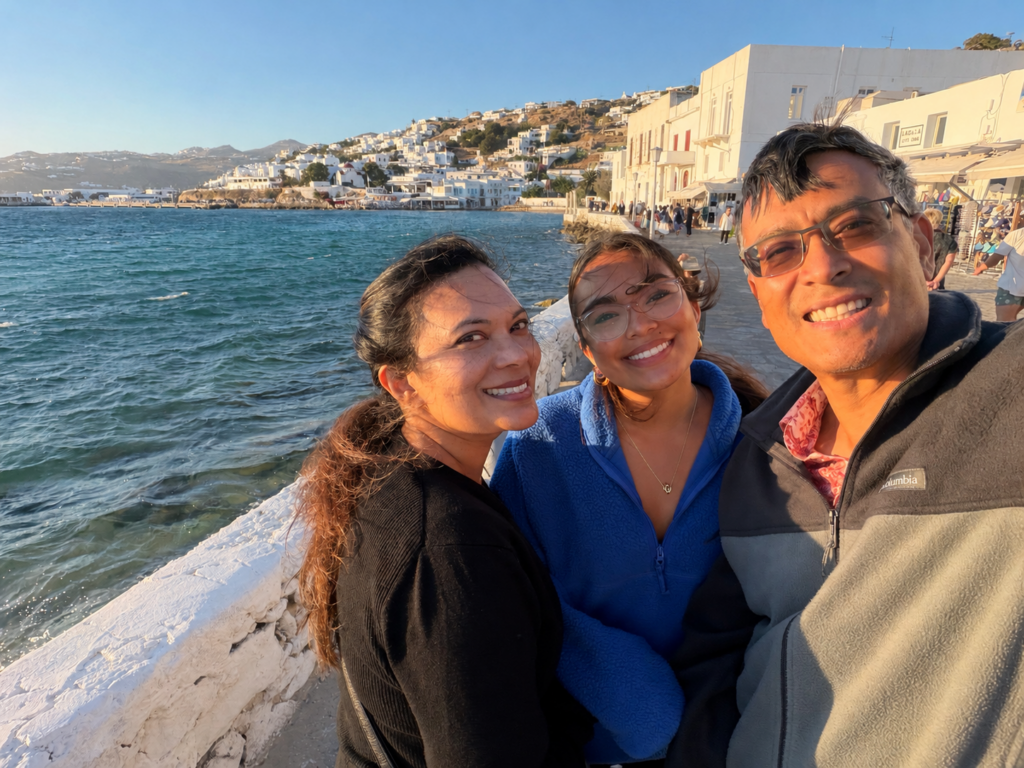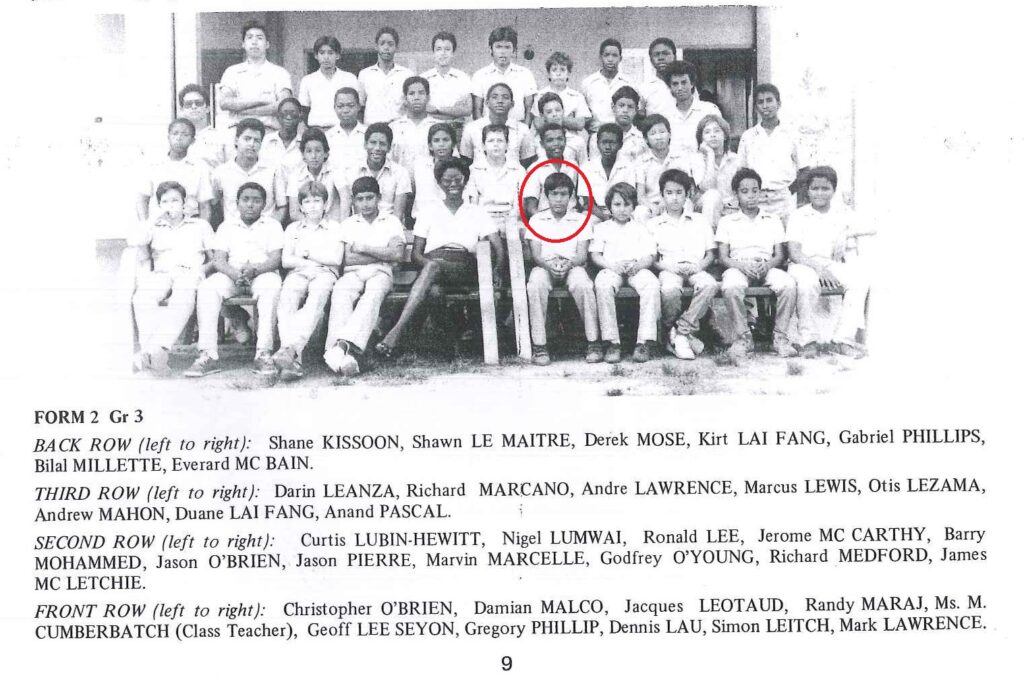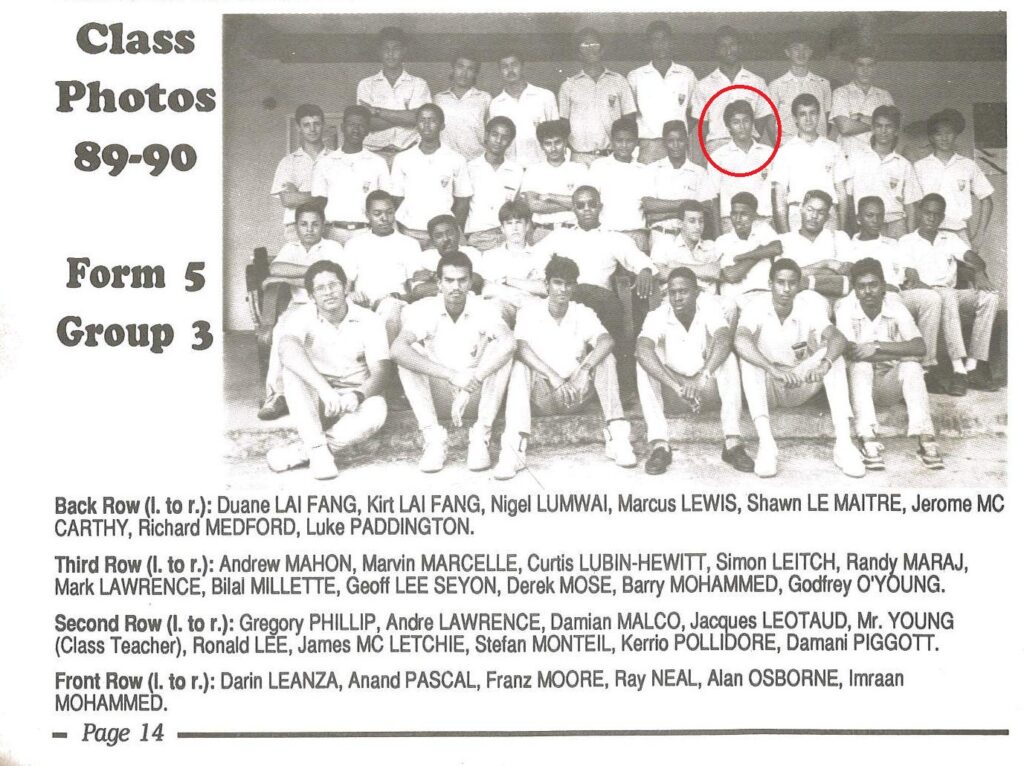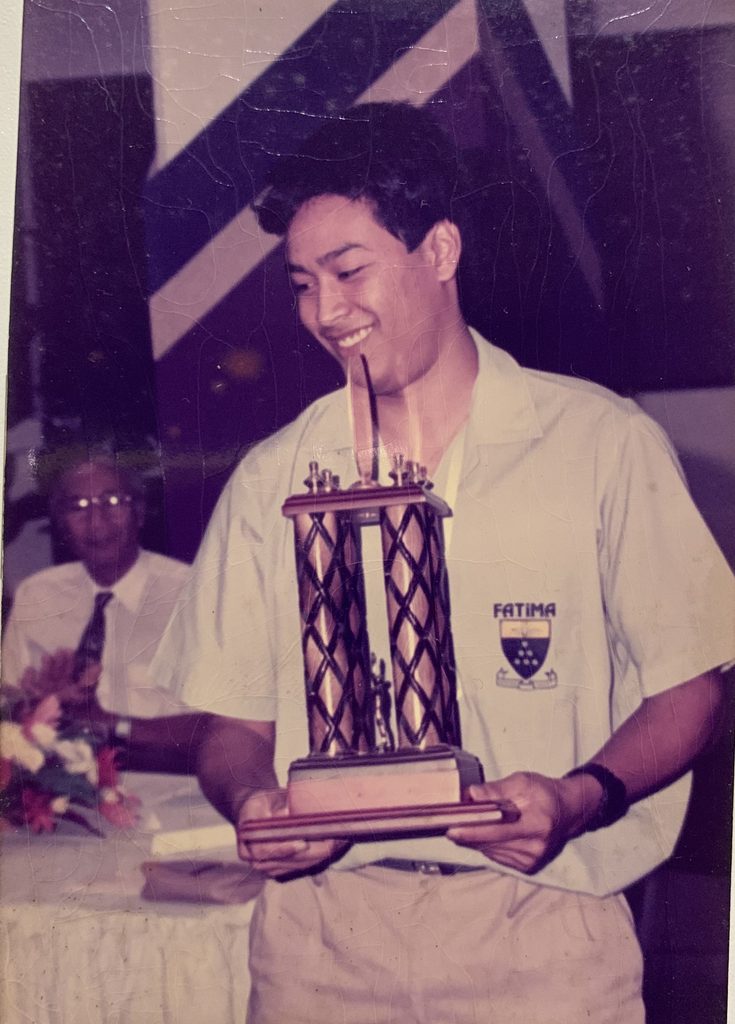

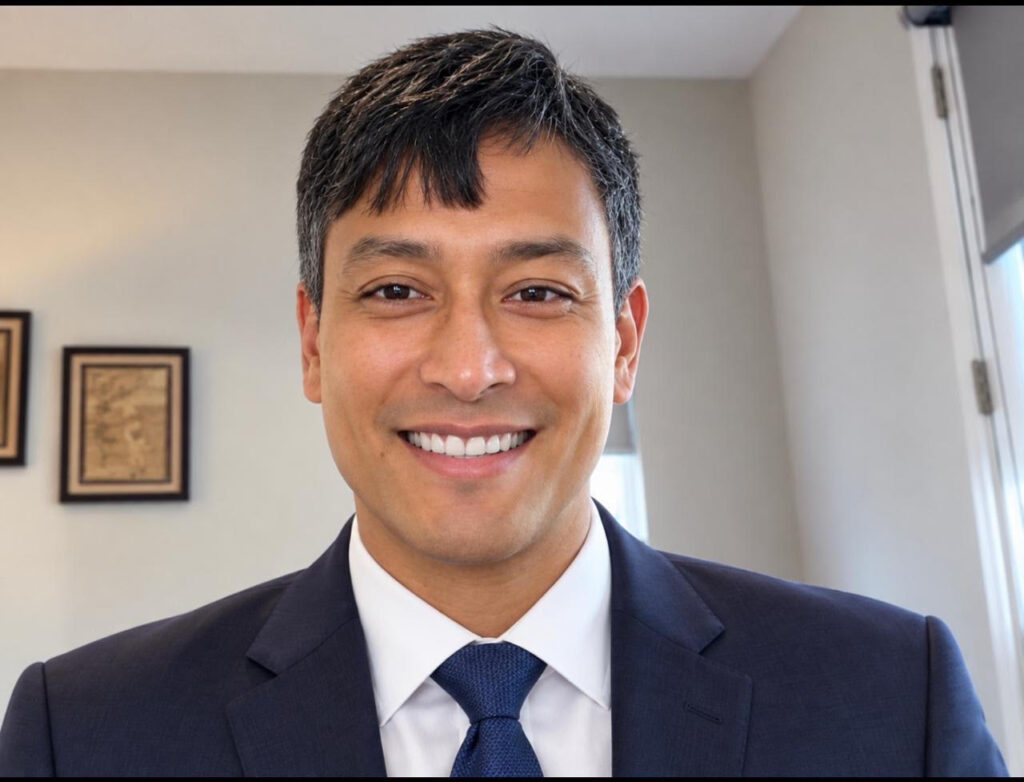
Geoff Lee Seyon is a National Open Scholar, high-tech CEO, and a trailblazer in the U.S. digital health industry. A proud alumnus of Fatima College, Mr. Seyon attended the school from 1985 to 1992, hailing from Guanapo Village, Arima. During his time at Fatima, he excelled in academics, sports, and leadership, embodying the values of discipline, innovation, and community.
Under the guidance of his most influential teacher, Mr. Harry Ramdass, Mr. Seyon learned the importance of being a well-rounded individual. He played cricket from the Giants B-Team to becoming Vice Captain of the First XI, representing Trinidad North Zone along the way. A natural leader, he was a founding member and Secretary of the 1991 Student Council and spearheaded the publication of the 1988-1991 Fatima Yearbook, raising over $15,000 in advertising for the school. His entrepreneurial spirit emerged early when he founded his first company, OmniSoft Computing Ltd., in Form 4 to provide custom software solutions.
After earning the National Open Scholarship for Business Studies, Mr. Seyon attended the Massachusetts Institute of Technology (MIT), where he completed both a Bachelor’s and Master’s degree in Computer Science with a focus on Artificial Intelligence in just four years. He later earned an MBA from Harvard Business School, the world’s leading institution for leadership, joining the ranks of other Fatima alumni like Robert Wickham and Richard Vieira.
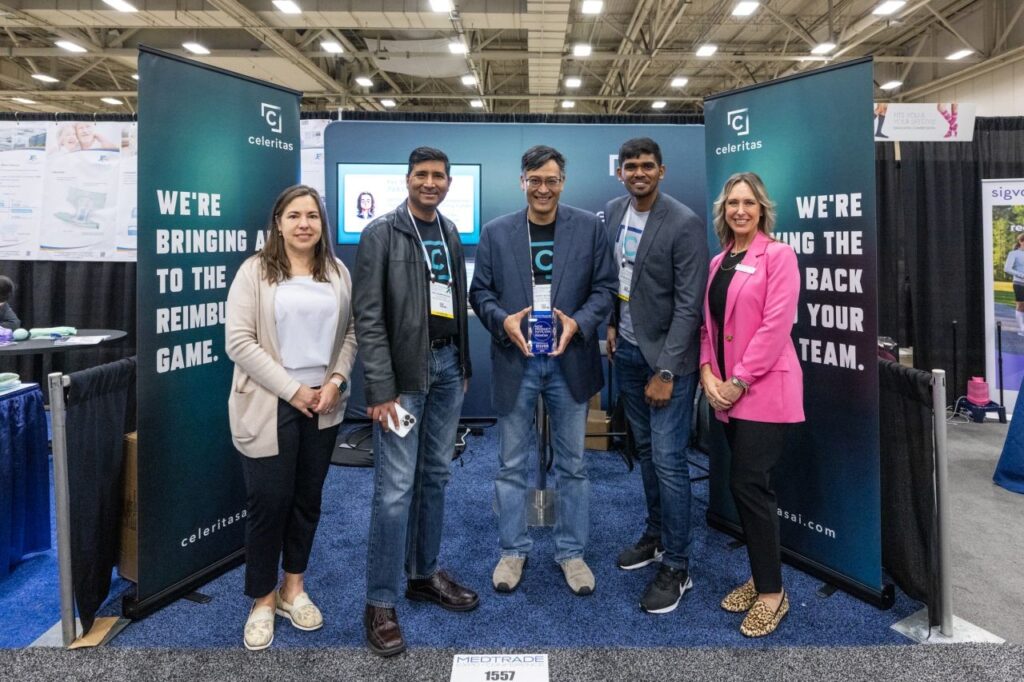
Today, Mr. Seyon is the Founder and CEO of Celeritas AI, an AI company revolutionizing billing for medical equipment and supplies. He has also made his mark in Silicon Valley, establishing STUDIO IXORA, a venture studio that has built several successful companies, including Livongo Health, which was acquired for $18.5 billion.
Mr. Seyon’s dedication to Trinidad and Tobago remains a cornerstone of his work. He has groomed talent through initiatives like Caribbean Tech Pioneers and hired numerous Trinidadians to his teams, including at Celeritas. As co-founder of Medullan, he built a “best of Boston” company, creating over 100 software jobs in Trinidad and leaving a lasting legacy before its acquisition by ZS Associates.
Mr. Seyon credits Fatima College for shaping his success, instilling in him the values of discipline, leadership, and community. His remarkable achievements and commitment to giving back make him a most deserving inductee into the Fatima Hall of Achievement 2024. See his Hall of Achievement of Induction here.
Q. Why did you select Fatima?
I selected Fatima College because it was recognized as a top school which also hosted one of the largest computer labs and strongest computer curricula, not just in Trinidad & Tobago but in the Caribbean as a whole.
In 1985, the Fatima Computer Lab housed 25 TRS-80 computers in an air-conditioned, U-shaped classroom, complete with whiteboards, AV equipment, and instructor stations at the front. After school, the lab offered lessons not only in BASIC programming, but also in industry-relevant software applications.
Under the leadership of Fr. DeFour and later Ms. Blackman, the school upgraded to IBM PC-compatible systems (8086-based), and later expanded with a Form VI lab featuring 80286 and 80386 machines.
I still remember the first time I used a spreadsheet during an after-school lesson in Form 1, taught by upper-form Fatima students themselves. (Coincidentally, 18 years later at Harvard Business School, I found myself seated in Aldrich Hall, Room 108, the very classroom[1] where Dan Bricklin first conceived the first spreadsheet software, VisiCalc[2].)
At age 10, selecting a school for Common Entrance felt like a small decision. In hindsight, it shaped the trajectory of my life. I’m deeply grateful to my parents and my Giuseppi Prep teacher, Mrs. Cheryl McEachrane, for guiding me at that pivotal point in time.
[2] https://qz.com/578661/dan-bricklin-invented-the-spreadsheet-but-dont-hold-that-against-him
Q. What is the worst mischief you got up to at Fatima?
I once gave the Trinidad Express an account explaining why the Student Council and I felt it was unfair to ban our two best Intercol players right before the season. The story made back-page headlines the next morning.
Mrs. Heywood, the Form Six Dean, and the administration were furious. One by one, senior leaders of the newly established Student Council were called into the Principal’s office to give their account of the situation. However, with everyone maintaining plausible deniability, no one could be directly held accountable.
In the end, the ban remained in place, and we lost the Intercol match and got knocked out.
Q. Any other favorite or influential teachers besides Mr. Ramdass?
Mr. Mark Ifill, my Physics teacher in Forms 4 and 5, was my favourite O’Level teacher. He had a unique sense of humor—part Fatima boy, part adult—which made him incredibly relatable as we ourselves were transitioning into adulthood.
Mr. Francisco (“Freeco”) Garcia, my Form 6 Physics teacher, was my favourite A’Level teacher. He didn’t just prepare us to excel academically, he inspired us to go beyond the classroom, to develop the curiosity and tenacity to question everything we encountered.
Mr. Garcia also played a key role in supporting students applying to MIT. Thanks to Robert Wickham, a group of Fatima alumni later organized a trip for him to finally visit MIT—a place he had sent so many of us to, but had never seen himself. During that visit, he was honored by the New England Science Teachers Association.
Q. What house were you in for Sports Day?
Ryan House
Q. Which parts of the school brings back your best memories?
As a computer enthusiast, the quiet solitude of the Computer Lab was one of my favourite places at Fatima. I remember writing my first assembly language program there as part of a friendly competition with Robin John and a few others.
The challenge was to place a character in the middle of the screen and have it move randomly—up, down, left, or right. I finished first, but I still remember that my “random” logic wasn’t quite right—the character consistently drifted to the right, suggesting my random number generator wasn’t truly uniform. Still, it was good enough for assembly code at the time. But just imagine that—we were writing Assembly code at age 16!
When Mr. Garcia taught us, his passion made the classroom feel like we were stepping into the labs of the great physicists who built the field, not just sitting in a Form 6 classroom.
In Forms 2, we were based in the Annex at the corner of Francis Lau and Gaston Johnson Streets. On days when a teacher didn’t show up, and we were tucked away far from the eyesight of the Deans, we’d sneak in games of “one-bounce Cricket” near the hedges. Interclass football and cricket matches on the quadrangle after school were always a highlight.
Our cricket coach, Kirk Newallo, occasionally brought in Trinidad and West Indies fast-bowler Ian Bishop to train us. As an opening batsman, I took those sessions seriously. One drill involved practising under the pavilion on a wet surface, using an old ball thrown at full force to create unpredictable bounce from a short distance. It taught you quickly whether to defend, duck, or simply absorb the hit—essential training against that level of fast bowling.
And there was the Fatima bus! It took us to places we had never been before (such as Barrackpore), and opened doors to unexpected opportunities. At one point, a calypso group even wrote a song about “De bus.”
And finally: Concerts in the Hall!
Q. What is the most valuable lesson you learned at Fatima?
The most valuable lesson I learned at Fatima was the importance of living a well-rounded life.
Mr. Harry Ramdass once told us, “You will earn respect if you commit seriously to something, like playing a sport for the school while also contributing to other aspects of Fatima life…rather than simply excelling academically.” My close friend Damani Piggott reinforced this idea early on. He encouraged me to take on multiple responsibilities so I could learn how to manage complexity later in life.
By Form 6, I fully embraced that challenge. I served as Vice Captain of the First Eleven cricket team, helped found and run the Student Council, contributed to repainting parts of the school, raised funds, helped publish three years of overdue yearbooks, and completed a demanding computer science project, often working 17-hour days while keeping up with my other academic responsibilities.
I carried that lesson forward. At MIT, despite the intensity, I remained involved in clubs, social activities, and mentoring. I also worked on MIT’s Library 2000 project whose principles helped shape modern cloud infrastructure, and built Caribbean Contact Point, a networking platform that connected me with Richard Vieira, who later became a key mentor and guided me toward Harvard Business School.
In retrospect, Harvard Business School valued not just academic and professional achievement, but also leadership and community impact. None of that would have been possible without the foundation laid at Fatima. The seeds planted by Mr. Ramdass and Damani shaped my path in ways I could not have imagined at the time.
Q. Have you been able to maintain friendships with your classmates since school? Any class reunions?
Many of my classmates still live in Trinidad. Since I’ve now spent more time in the U.S. than I did growing up there, I’ve inevitably lost touch with some.
However, I’ve remained close with a core group, including Damani Piggott, Nicholas Fuller, Nigel Howard, Pedro Gonzalez, and Jason Arneaud (with whom I co-founded OmniSoft). I’ve also recently reconnected with Jeffrey Faustin, who is building a fund focused on Caribbean entrepreneurs with global reach.
Looking back, I do wish reunions in the earlier years such as the 5th, 10th, 20th had been more consistently organized. This is something FOBA could potentially strengthen for future classes.
Q. Tell us about the start of Omnisoft Computing. Were you still involved after you left Fatima? Is it still around?
I had three early “startup-like” efforts at Fatima, with the third, OmniSoft Computing Ltd., being the most significant. It was founded in Form 4 by Gareth Jenkins, Robin John, Jason Arneaud, and myself.
At the time, Robin obtained a copy of Borland’s Object-Oriented Turbo Pascal. While we were being taught procedural Pascal for O’ Level Computing, we quickly realized that the accompanying libraries were powerful enough to build real, production-level software. That realization inspired us to offer our skills to industry.
We had a strong team dynamic: Gareth was the networker, Robin was relentless in execution, Jason was a visionary well ahead of his time, and I contributed where my skills aligned with building something meaningful. In the early years, OmniSoft was more of a passion project than a business. We lacked the commercial experience to monetize effectively. Our first real project came a few years later, when Robin secured a client. We built an inventory system for a boat owner, including cataloging his CD collection. We poured everything into that project and deepened our mastery of Turbo Pascal in the process.
When our A’ Level projects came around, it was clear we would use this same toolset, much to the surprise (and perhaps concern) of our teachers as most students were still working with BASIC or procedural Pascal.
The result was: two exceptionally large and detailed submissions to the Cambridge Examination Board, of around 400 pages each. I recall the Board responding that such extensive projects were unusual, noting that even many Master’s-level submissions were only 50 pages. While we were proud of the work, the experience taught us discipline and depth that later proved invaluable in our University studies and later real jobs.
After graduating in 1992, Robin formally incorporated OmniSoft and ran it full-time. Gareth had moved on, while Jason and I pursued roles at TIDCO and IBM respectively, remaining involved as Directors. OmniSoft operated successfully for nearly 20 years before Robin eventually closed the business to pursue other opportunities.
Although it began as a student project, it was a formative experience that shaped how we thought about building technology and tech companies, and I’m grateful to have been part of it. Looking back, OmniSoft taught me that building something real, even imperfectly, was going to be the fastest way to really learn.
Q. You were recruited into Sapient Corporation by Fatima College 2017 Hall of Achievement inductee, Anthony Jules (Class of 1984). Have you ever collaborated with him or any other notable Fatima alumni on AI-related projects?
No. Anthony Jules was already well ahead of me professionally by the time I joined Sapient Corporation, so we never had the opportunity to collaborate closely on the same initiatives. However, I remain deeply grateful that he interviewed me at MIT and gave me the opportunity to join Sapient early in my career. That experience became a foundational part of my professional journey.
We still keep in touch out here in Silicon Valley as he continues to partner with AI Industry pioneers to build the next greatest Physical AI/Robotics companies.
Q. You co-founded Caribbean Tech Pioneers, a non-profit focused on advancing AI and entrepreneurship in emerging markets. What year was this and how has it progressed over the years?
Caribbean Tech Pioneers (CTP) was conceived in August 2020, when Dr. Mark Moyou and I met while serving as guest lecturers for BP Trinidad & Tobago’s “Crash Course in AI.” After that event, we both felt there was a missing bridge between academic theory and real-world readiness for young Caribbean professionals. Mark said something that stayed with me:
“We have a unique opportunity to fill in the gaps of formal education and fast-track someone’s ability to provide value to the marketplace. The marketplace isn’t everything, but when someone learns to drive real change, it uplifts entire communities.”
That conversation became the seed for Caribbean Tech Pioneers—a mentorship network focused on University students and early-career professionals typically between ages 19 and 29. Our goal was not simply to teach technical skills, but to help young people build confidence, sharpen communication abilities, and learn how to thrive within high-performance teams.
By late 2021, we had assembled over 40 Caribbean professionals working at organizations such as Google, DeepMind, IBM, Microsoft, NVIDIA, and Meta, along with researchers and startup leaders around the world. These mentors volunteered their time to support more than 100 young Caribbean technologists through sessions on topics such as:
- building a credible LinkedIn profile
- crafting a world-class résumé
- preparing for global tech interviews
- navigating careers in AI.
We also created a series of podcasts/YouTube videos sharing views from accomplished Caribbean professionals about the emergent opportunities and careers in AI and data science.
In early 2023, we decided to move beyond mentorship conversations and build something tangible. We launched a 10-week AI mentorship lab where 10 members collaborated on a real-world software project led by Dr. Moyou, NVIDIA engineer Taurean Dyer, and myself. That initiative ultimately became the foundation for Celeritas AI, a Silicon Valley company focused on applying AI to operational challenges within a major segment of the U.S. healthcare industry.
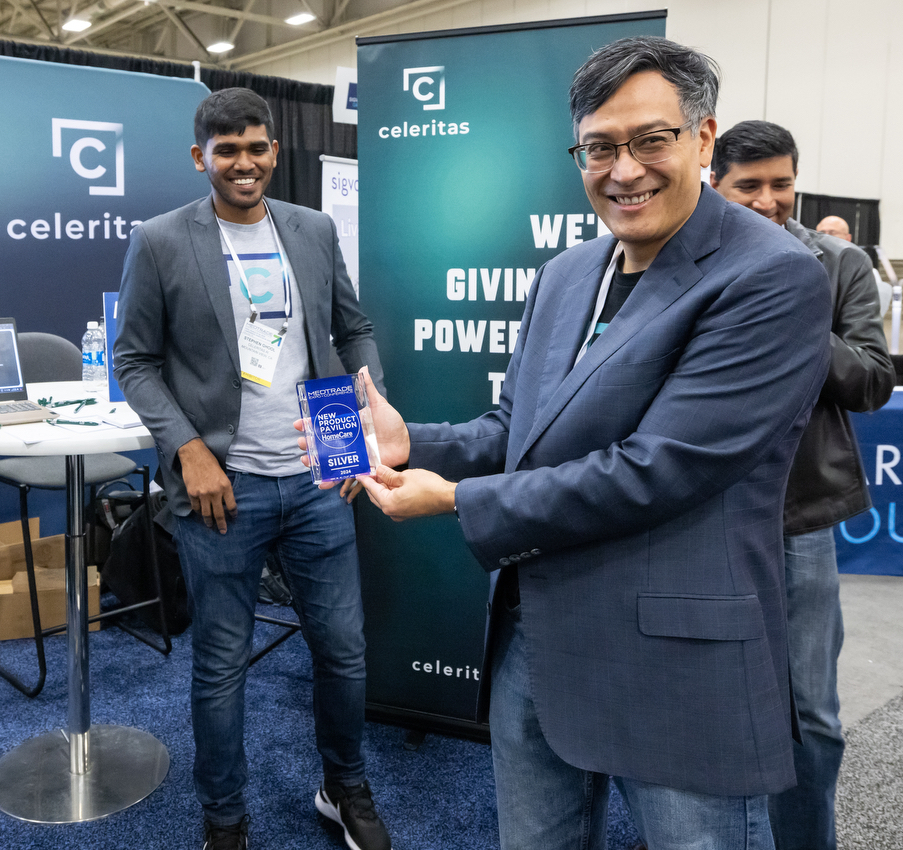
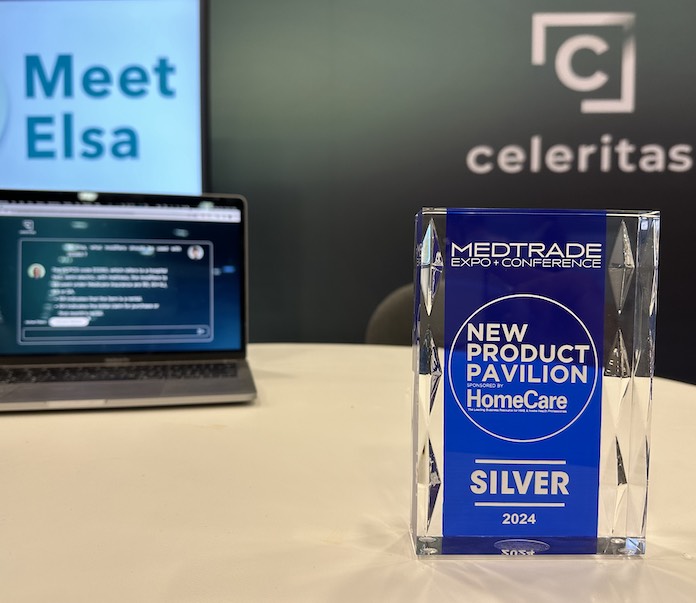
Today, more than half of Celeritas AI’s 15-person team has Caribbean heritage, including four of our five leadership team members. The company has won “Best New Software” awards in our industry, and continues to work with some of the largest clients in the industry. One of our earliest mentees, Stephen Ghool, is now our Senior AI Engineer, leading customer-facing technical systems. Another, Daniel John, joined us as an AI developer and leads one of our most important modules.
In many ways, CTP evolved from mentorship into momentum—a living example that Caribbean talent can compete and build at a world-class level. As I often tell students and parents alike:
Our goal was never simply to teach AI. It was to prove that young Caribbean minds could play key roles in shaping the future of arguably the world’s most important industry today.
Q. Tell us about the origins of your desire to give back to Trinidad & Tobago.
Between 1993 and 1997, I lived on the 11th floor of MIT’s MacGregor House in Cambridge, Massachusetts. The building overlooked the Charles River, downtown Boston, and much of MIT’s campus. Along the walk back to the dorm was a long brick wall which students appropriately nicknamed “The MacGregor Wind Tunnel.”
When I first arrived at MIT in August 1993, the weather was beautiful. During orientation, there were outdoor events, barbecues, and even casual games of cricket. It felt idyllic. But as the semester progressed, the days shortened, temperatures dropped, and the reality of a Boston winter set in. By late October, temperatures had fallen dramatically, and with the wind tunnel effect, the cold became physically punishing.
I vividly remember one winter evening walking to a Caribbean restaurant in near-zero-degree weather, unable to feel my nose or ears through the freezing wind. That experience planted an important question in my mind:
Why couldn’t we pursue world-class opportunities while still living in the warmth, culture, and community of the Caribbean?
That idea became a long-term mission for me. At MIT, I organized a conference on “The Internet in the Caribbean,” discussing how emerging technologies could eventually enable global work from the region itself. Later, while working at Sapient Corporation, I advocated internally for Trinidad as a potential nearshore technology destination, arguing to Sapient’s leadership that it could provide a culturally aligned alternative to traditional offshore models.
At Harvard Business School, I developed business plans around building technology operations in the Caribbean, and I explored a partnership with Neal & Massy key executives to help make that vision real. Ultimately, none of the traditional career paths available to me after business school fully aligned with that goal. So I decided to pursue it myself.
Through Franklin Winston LLC, we invested in Medullan, a digital health technology company where we eventually scaled roughly 80% of the team in the Caribbean. To me, Medullan was not just a business—it was an opportunity to create the type of environment I had once wished existed myself to provide the ability to work with world-class clients and technologies while remaining close to home, family, culture, and community.
During its growth, Medullan created more than 100 jobs in the Caribbean, and many former team members went on to become technology leaders, executives, and founders themselves. That multiplier effect of helping talented people build meaningful careers without necessarily leaving the Caribbean permanently is one of the accomplishments of which I am most proud.
Q. What advice would you give to any Fatima student interested in a career in the AI field?
Within the next five years, almost everyone will work alongside AI in some capacity, whether they realize it or not. In many ways, asking about a career in AI today is similar to asking about a career involving the Internet in 1995. AI will become embedded into nearly every profession. For students who aspire to reach the highest levels of the field, my advice would be:
1. Build a strong foundation in Computer Science and Mathematics.
Attend the strongest university you can, particularly one with deep AI expertise such as Massachusetts Institute of Technology, Carnegie Mellon University, or similar institutions.
2. Master Python and learn how modern AI systems are actually built.
Understanding prompts and large language models is useful, but building a simple chatbot wrapper alone does not represent the full scope of enterprise AI.
3. Learn the three major pillars of modern AI:
- Generative AI and large language models
- Deep Learning and neural networks
- Symbolic AI and reasoning systems
4. Build real projects.
Whether through internships, startups, research labs, or open-source work…practical experience matters enormously.
5. Join ambitious teams.
Working at a strong startup or world-class technology company teaches lessons that cannot easily be learned in a classroom alone, and likely not in many Caribbean work environments.
AI is ultimately not just about technology. It is about learning how to solve the next level of the most meaningful human problems responsibly, and in doing so participating in the part of the coming economy that will matter the most.
Q. Do you still have family in Trinidad and do you return to Trinidad often?
Yes. My father, mother, brother, and sister-in-law still live in Guanapo Village, Arima. These days, it is often easier for one or more of them to travel to the U.S. so we can spend time together here. The same is true for several members of my team at Celeritas AI.
When I was running Medullan and approximately 80% of the team was based in Trinidad while I lived on the U.S. East Coast, I could justify visiting three or four times per year. Now that I live on the West Coast, trips are less frequent, typically once every two to three years.
Q. What is the first thing you would eat on a trip back to Trinidad?
A dhalpuri beef roti from Boissiere Village (with slight pepper).
Q. What do you miss the most about Trinidad?
I miss being able to sit on a beach like Maracas in Trinidad or Store Bay in Tobago and simply enjoy the warmth of the water, the sound of the waves, and the slower pace of life.
And of course, knowing that afterward you can go get shark and bake from Richard’s or crab and dumplings from Mrs. Jean’s doesn’t hurt either.
Q. Favorite way to spend spare time (assuming that you have spare time)? Any hobbies or interests?
I most enjoy spending time with my daughter. I’m not a helicopter parent. I enjoy watching her grow, discover herself, and pursue opportunities that are already well beyond what I had access to at the same age. When she is at school, I’ve been rediscovering golf after more than 20 years away from the game.
As someone with a cricketing background, it has been surprisingly challenging to retrain my instincts from swinging a straight bat to swinging a golf club on plane. But there is something deeply satisfying about seeing a well-struck golf ball fly straight through the air with good timing and technique.
Q. Tell us about your family (wife, children).
My wife is Afsana Akhter, and we have one daughter, Amani Lee-Seyon, who is currently 16 years old and finishing 10th grade in the United States. Afsana is originally from Bangladesh and is also an engineer by training, having studied Electrical Engineering and Computer Science at the Massachusetts Institute of Technology. After a start in technology sales, she later became a digital health startup executive. One of her greatest strengths is her calm and reassuring presence—and she can sing beautifully as well!
Our daughter, Amani, was born in Boston. Her name means “hopes and aspirations,” and she has truly been the greatest gift in my life. She is highly perceptive, creative, and remarkably well-rounded—strong academically across both STEM and the humanities, while also deeply committed to volleyball as an outside and middle hitter.
As well, she plays piano and reads music fluently at a level well beyond anything I achieved during my own classical guitar training.
Q. When travelling on a plane, window or aisle seat?
If I’m traveling with my daughter, she gets the window seat. Otherwise, if I’m traveling alone, I’ll usually take it myself.
Q. If you could visit anywhere in the world now for vacation, where would it be?
I’d love to visit Mexico City, along with less-touristed places such as Los Cabos and Mazatlán, especially during the colder months here in Northern California. Though I’ve lived in California for 11 years, there are still many quaint small towns that I’d like to spend time visiting as a contrast to the bustling metropolitan Bay Area. I of course would jump at the opportunity if the schedule affords it to take my family to Tobago for a quiet few days.
Q. Which sport(s) do you follow? Any favorite players or teams?
Despite the WI decline over the past couple of decades, I remain a die-hard supporter of the West Indies cricket team. One of the most inspiring recent stories was that of Shamar Joseph rising from working as a security guard in Guyana to helping the West Indies defeat Australia at the Gabba —a finish to the series few people thought possible. Moments like that reignite belief among longtime supporters.
I also continue to admire Ian Bishop, both for his contributions to cricket commentary and for the generosity he showed when he occasionally helped train us during my Fatima cricket days. I thought Jason Holder was an excellent leader for the West Indies side, though unfortunately his era never fully reached the heights many hoped for.
I do not follow American sports particularly closely. I’ll watch the Super Bowl for the atmosphere, wings, nachos, and the halftime show. I also follow the FIFA World Cup every four years, and since North America is hosting in 2026, perhaps I’ll finally have the opportunity to attend a match in person.
Q. Any role models?
When you are younger, your role models often come from the academic or professional worlds you aspire to. But as you grow older, values begin to matter even more than accomplishments.
Today, my greatest role models are my parents, Frank and Zalima Lee Seyon. From them I learned creativity, communication, resilience, ethical grounding, risk tolerance, and dedication to excellence. I am grateful to still have both of them in my life, and I especially value the opportunity for my daughter to experience those same values through them as well.
Q. What is the best advice you’ve ever received?
The best advice I ever received came from my father. He taught me that when you face an obstacle, or something that frightens you, the best course of action is usually to move toward it, confront it directly, and do the work necessary to overcome it.
Life is full of fear, uncertainty, and setbacks. But if you can overcome even 1%, 5%, or 10% more than most people over time, the results compound dramatically.
I also remember hearing when I was younger that there are three types of people in life:
- “those who watch things happen,”
- “those who wonder what happened,”
- “and those who make things happen.”
You always want to strive to become the third type.
Q. With all your accolades and experience, what would you say has been the highest point of your life/career so far? Your proudest moment?
My life and career have been a series of moments where I took risks, embraced uncertainty, worked relentlessly, and then found new doors opening as a result.
- Fatima gave me values, friendships, and discipline.
- MIT gave me technical depth and work ethic.
- Sapient gave me mentorship and professional rigor.
- Harvard Business School gave me confidence, perspective, and the ability to process complex decisions quickly.
- Medullan taught me the healthcare industry and allowed me to help build opportunities for others.
- Silicon Valley exposed me to another level of ambition and innovation.
- Caribbean Tech Pioneers allowed me to mentor and identify the next generation of extraordinary young talent exactly when the biggest AI boom began.
- And…Celeritas AI is still an unfolding chapter whose future is yet to be written.
Ultimately, none of my academic or professional accomplishments compare to becoming a father. Anyone who has experienced parenthood understands how profoundly it changes your perspective on life. It reshapes your priorities completely. For me, that has been life’s greatest reward.
Q. Any bucket list item(s) still to achieve in your life (career/personal)?
One of the goals I wrote about in my Harvard Business School application essays was: the ambition to become the first Trinidadian CEO to take a technology company public on the NASDAQ. We’ll see how that story ends!
Q. What does ‘Nitendo Vinces’ mean to you?
I remember Fr. DeFour once telling us: “Life is a struggle—a struggle between the forces of good and evil.”
In many ways, that perspective captures what Nitendo Vinces means to me today. Great things are rarely built by people motivated only by money, ego, or short-term rewards. The most meaningful achievements come when people dedicate themselves to a purpose larger than themselves.
Fatima planted many of those early leadership seeds in us: confidence, discipline, responsibility, and service to others. But once you leave school, it becomes your responsibility to carry those values forward.
Q. How did it feel to be inducted into the Fatima College Hall of Achievement?
Honestly, it felt overwhelming. I still feel as though I am only halfway, or perhaps two-thirds, through the journey. There is still so much more I hope to build and contribute.
I am deeply grateful to Fatima College and the Hall of Achievement committee for recognizing me among such an accomplished group of honorees. The recognition serves as encouragement to continue working on things that matter, not only for myself, but for the communities and people who helped shape me.
(Although I was unable to attend the ceremony in person, my mother and brother accepted the award on my behalf. Hopefully, in the near future, I’ll be back in person to celebrate properly with all of you.)
Q. Any closing remarks?
I suspect the Fatima Old Boys’ Association conducts these interviews to help younger students identify patterns, motivations, and values that may guide them toward meaningful lives of their own. In answering these questions, I’ve tried to share not just accomplishments, but the deeper motivations and principles that shaped many of the decisions I made along the way.
If any part of my story resonates with readers, I hope it encourages you to embrace the struggle of growth, learning, discipline, and service over the course of your own lifetime. Success rarely happens all at once. It is usually the cumulative effect of small acts of discipline, resilience, curiosity, and courage repeated over many years. And during the difficult seasons of life, never underestimate the value of community: family, friends, classmates, teachers, mentors, and the broader Fatima network around you.
At every major milestone in my own life, I’ve tried to pause, reflect on the principles I was taught early on, and then ask myself: What meaningful challenge comes next?
For me, the journey has ultimately been about learning how to build meaningful things alongside great people. A famous founder once left behind a simple but enduring piece of advice:
“Stay hungry. Stay foolish.”
Nitendo Vinces
2024 Interview